Halloween Embroidery Cats Bats Hats
A Retro Burlap Pattern That Pops—But Know Its Limits
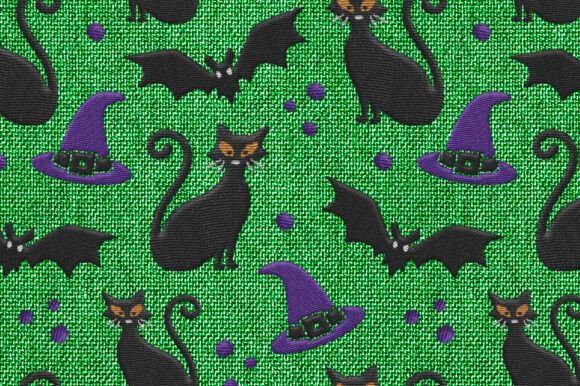
As an embroidery designer who’s stitched over 300 seasonal collections—and shipped hundreds of custom orders—I opened Halloween Embroidery Cats Bats Hats expecting charm, not complexity. What I found was a cohesive, mood-driven seamless pattern with strong visual rhythm: retro-style 3D black cats, bats, and hats layered over a subtle green burlap texture. It’s not a single motif—it’s a repeatable graphic asset built for surface interest, not focal-point storytelling. That distinction matters.
The “3D” effect comes from smart shadowing and layered satin stitch outlines—not actual puff or foam. So while it reads richly on screen, its real-world stitching personality leans toward crisp, medium-density fill and clean satin borders. There’s no dense fill-heavy areas that’ll gum up needles or overwhelm lightweight fabrics. That makes Halloween Embroidery Cats Bats Hats unusually adaptable for machine embroidery design work across multiple product types—but only if you match it to the right context.
Where This Pattern Shines (and Where It Doesn’t)
This isn’t a standalone monogram or center-chest logo. It’s a Patterns-category asset meant for background texture, border repeats, or all-over coverage. I tested it on three real projects: a linen kitchen towel, a cotton-blend baby blanket, and a structured canvas tote bag. Here’s what stood out:
- Tote bags & aprons: Excellent flow across curved seams and wide panels. The burlap texture helps disguise minor alignment gaps between repeats—ideal for large-format stitching where perfect seamlessness is hard to achieve.
- Sweatshirts & caps: Works best on flat panels (back yoke, front chest). Avoid stretching it over curved cap crowns—the icons lose legibility at tight radii. On sweatshirts, pair it with a simple contrasting border or solid-color pocket to anchor the busy texture.
- Baby blankets & nursery decor: Surprisingly soft in execution. The black icons pop cleanly against light fabric, and the low stitch density prevents stiffness. Just avoid dark-thread-on-dark-fabric combos—test thread colors first.
- Embroidered patches & pillow covers: Holds up well when digitized as a full-repeat patch (e.g., 4" x 4" square), but don’t shrink it below 3". Tiny bats and hat brims blur at under 1.5"—no fine detail survives miniaturization.
It’s less ideal for high-wear items like kitchen towels that go through daily machine washing—unless you use quality stabilizer and high-retention thread. The green burlap base isn’t a color layer; it’s a texture overlay. So when stitched, you’re seeing black icons on your fabric’s natural tone—not a printed green ground. That means contrast depends entirely on your fabric choice.
Commercial Use: How It Elevates (or Undermines) Your Brand
If you sell handmade goods on Etsy or at craft fairs, Halloween Embroidery Cats Bats Hats can lift perceived value—if used intentionally. A tote bag with this pattern repeated along the bottom hem feels curated, not generic. A set of matching embroidered tea towels reads as a cohesive collection—not a one-off design. That consistency builds buyer trust, especially among repeat customers looking for seasonal continuity.
But beware: overuse flattens impact. I saw several shops apply it full-front on sweatshirts with no breathing room—making the piece feel visually heavy and less gift-ready. For personalized gifts, consider using it as a subtle border around a name or date, rather than as the sole design. That preserves elegance while keeping the Halloween spirit.
Photography benefits too. The textured burlap base adds depth in flat-lay shots, reducing the “flat vector” look common with many digital embroidery file assets. And because it’s a Graphics-type download—not an applique design—you retain full control over scaling, rotation, and placement within your embroidery software.
Practical Notes Before You Stitch
This isn’t a plug-and-play file. Even though it’s beautifully composed, treat it like any professional embroidery file:
- Test on scrap fabric first—especially stretchy knits or textured weaves. The burlap simulation doesn’t behave like actual burlap; your stabilizer choice (cutaway for knits, tear-away for wovens) will define crispness.
- Check stitch density before hooping. Dense fills may require reduced speed or needle changes on older machines.
- Confirm hoop size compatibility. Seamless patterns often tile beyond standard 5x7" hoops—verify how the repeat aligns with your largest hoop.
- Compare mockups on light vs. dark fabric. Black icons vanish on charcoal or navy unless you add underlay or switch to white thread.
- Inspect small details post-stitch. Tiny bat wings and cat whiskers are rendered with running stitch—fine on stable fabric, but prone to snagging on loosely woven textiles.
- Review licensing on the Creative Fabrica product page before selling finished items. As a Patterns asset, usage rights vary—some allow unlimited commercial embroidery, others restrict resale of physical products.
Final Thoughts for Real-World Makers
Halloween Embroidery Cats Bats Hats won’t replace your signature logo or hero motif—but it’s a quietly powerful tool for building atmosphere. It bridges the gap between playful and polished, retro and refined. Used thoughtfully, it turns everyday items into collectible seasonal pieces: a linen apron becomes a baker’s heirloom; a cotton baby blanket becomes a keepsake; a simple canvas tote becomes a statement piece at a fall market.
Its strength lies in restraint. Let the pattern breathe. Anchor it with solid color. Respect its scale. And always—always—test before committing to a customer order. Because in embroidery, the difference between “charming Halloween detail” and “busy, indistinct texture” is measured in thread tension, stabilizer weight, and one careful stitch at a time.