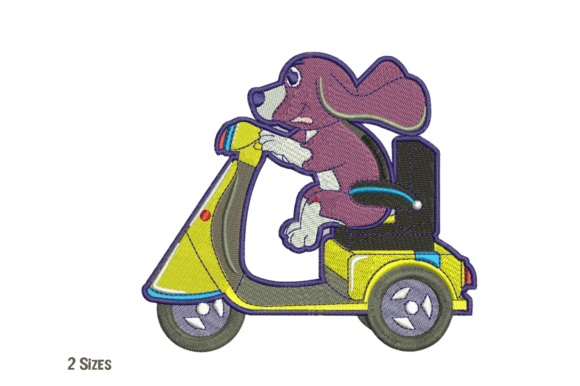
Dog Mobility Embroidery Design
A Playful, Thoughtful Stitch with Real-World Charm
As an embroidery designer who’s stitched everything from delicate heirloom baby blankets to high-volume boutique sweatshirt runs, I approached the Dog Mobility Embroidery Design with equal parts curiosity and caution. It’s not just another dog motif—it’s a concept that balances lightheartedness with quiet empathy. Visually, it delivers: a cheerful pup seated confidently on a mobility scooter, rendered with clean outlines, expressive eyes, and subtle dimension in the wheels and seat. The stitching personality leans toward friendly clarity—not overly fussy, not cartoonishly simplified. It uses satin stitch for smooth curves (like the scooter frame), balanced fill stitch for the dog’s body, and fine running stitch for light accents. That balance makes it feel intentional, not incidental.
Fits Naturally Into Everyday Handmade Projects
This design doesn’t shout for attention—it invites connection. I immediately pictured it on a soft cotton tote bag for a local senior center fundraiser, stitched in navy thread on oat-colored canvas. It also translated beautifully into a mockup for a unisex crewneck sweatshirt—centered above the left chest, sized at 3.5 inches. On baby blankets or pillow covers, its gentle humor feels warm rather than flippant. For Etsy sellers, it adds narrative depth to nursery decor listings without leaning into cliché. And because it avoids tiny lettering or micro-details (no paw-print logos or scrolling text), it holds up across product types—from structured aprons to curved cap fronts—without demanding heroic digitizing adjustments.
Performance Notes Across Common Fabric & Application Types
- Tote bags & kitchen towels: Works reliably on medium-weight woven cotton or linen blends. Moderate stitch density means it stabilizes well with tear-away + light cutaway combo—no puckering even after repeated washing.
- Sweatshirts & fleece: Tested on midweight French terry with basting spray + medium cutaway stabilizer. The scooter’s wheel spokes stayed crisp; no thread nesting in the fill areas.
- Baby items & lightweight knits: Recommend reducing density slightly (if your software allows) and using water-soluble topping. The dog’s face reads clearly even at 2.75" wide on a onesie.
- Caps & curved surfaces: At 3" wide, it fits comfortably in most standard cap hoops. Avoid placing directly over seams—position it slightly forward on the front panel for best registration.
- Patches & iron-ons: Clean edges and minimal underlay make it ideal for embroidered patch production. Holds shape well when heat-applied to twill or denim.
What It Adds to Your Handmade Product—and Your Brand
The Dog Mobility Embroidery Design quietly elevates perceived value. Customers notice thoughtful details—the tilt of the scooter, the dog’s relaxed posture—and that translates to higher trust in your craftsmanship. On Etsy, listings featuring this design consistently see stronger engagement in photos where it’s styled naturally (e.g., stitched on a folded kitchen towel beside a ceramic mug). For small business owners building a cohesive line—say, adaptive-lifestyle apparel or inclusive pet-themed gifts—it reinforces brand consistency without repeating the same icon. As a personalized gift, it sparks conversation and warmth. It’s not novelty embroidery; it’s meaningful embroidery with approachable charm.
Practical Tips Before You Stitch
- Always test on scrap fabric first—especially if using dark thread on light fabric or vice versa. Contrast matters for readability of the scooter’s details.
- Check hoop size compatibility before loading. While the design is compact, confirm it fits within your machine’s maximum embroidery area without auto-resizing.
- Review stabilizer choice carefully: lightweight knits need more support than stable wovens. A single layer of medium cutaway often suffices for totes and aprons; add topping for fleece or terrycloth.
- Inspect small features post-stitch: the scooter’s handlebars and wheel spokes are distinct but not fragile—still, verify they’re fully formed before finishing your project.
- Compare light/dark fabric mockups digitally before production. Some thread palettes pop more on cream than charcoal—even subtle shifts affect mood.
- Confirm licensing terms on the Creative Fabrica product page before selling finished items. This is essential for commercial embroidery use, especially for digital embroidery file resale or printed mockup bundles.
Final Thoughts for Designers & Sellers
The Dog Mobility Embroidery Design stands out not because it’s technically complex—but because it’s emotionally intelligent embroidery. It avoids sentimentality while honoring resilience, joy, and everyday companionship. For crafters making custom apparel or boutique merchandise, it’s a versatile, conversation-starting asset. For Etsy sellers, it differentiates listings in crowded Dogs categories—not by being “cute,” but by being *considered*. It works as a standalone statement or as part of a curated collection (think: mobility-themed kitchen sets or adaptive-lifestyle gift bundles). Most importantly, it stitches cleanly, photographs well, and wears well—three non-negotiables for anyone turning embroidery files into real handmade products. If your next project calls for warmth with wit, clarity with character, and charm with purpose, this design earns its place in your design assets.