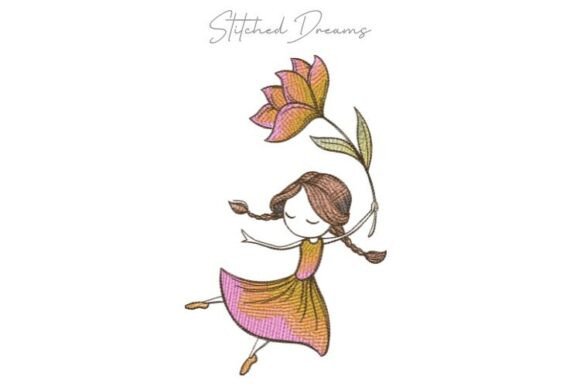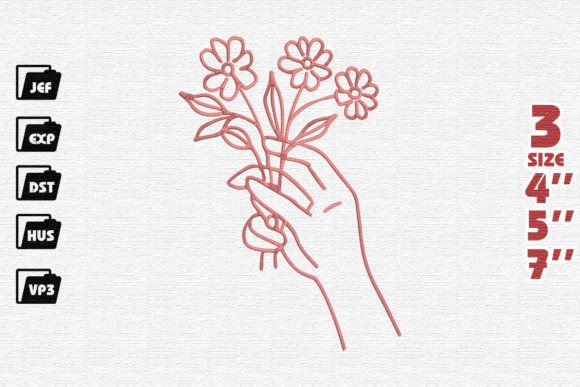
Hand Holding Flowers Embroidery
A Practical Review for Small Business Merch & Branded Patches
As an embroidery designer who’s developed hundreds of commercial designs for cafés, florists, boutiques, bakeries, and handmade brands, I approach every new machine embroidery design with two questions: Does it communicate brand values at a glance? and Will it hold up across real-world production conditions? When I first saw Hand Holding Flowers Embroidery, my instinct was positive—it evokes warmth, care, and gentle craftsmanship. But instinct isn’t enough for small business merch. So I tested it across six common applications: embroidered patches, apron embroidery, cap embroidery, tote bag design, staff uniform accents, and product packaging labels.
First Impression: Friendly, Handmade, and Professionally Approachable
The title alone—Hand Holding Flowers Embroidery—sets clear visual expectations: organic flow, human scale, botanical softness. It reads as joyful and charming (as the description states), but more importantly, it reads as intentional. This isn’t generic clipart—it suggests narrative, care, and connection. For small businesses rooted in community—like a neighborhood florist, a ceramic studio, or a pet wellness brand—it reinforces authenticity without leaning into cliché. It avoids looking too rustic (no distressed edges or faux-vintage textures) or overly delicate (no fragile stems or microscopic petals). That balance makes it versatile across industries—and critical for maintaining brand identity across diverse touchpoints.
Where It Shines in Real Business Use
- Embroidered patches: Works beautifully as a 2.5"–3.5" woven or chenille-style patch. The hand shape provides natural negative space; flowers fill it without overcrowding. Ideal for attaching to denim jackets, canvas totes, or staff lanyards.
- Apron embroidery: Perfectly sized for left-chest placement on cotton or linen aprons. The upward curve of the hand echoes natural posture—subtle but psychologically reassuring for customers seeing staff in branded gear.
- Cap embroidery: At 2" wide, it maintains legibility on structured front panels. Unlike dense floral motifs, the open hand silhouette prevents stitch pile-up and reduces risk of puckering on curved surfaces.
- Tote bag design: Scales well to 4"–5" when placed near the handle seam or centered on the front panel. Its asymmetry adds visual interest without competing with printed logos or slogans.
- Uniform accents: As a sleeve detail or pocket overlay on work shirts, it signals attention to detail—elevating perceived professionalism without formality.
- Product packaging & gifts: Stitches cleanly onto kraft gift tags, fabric pouches, or reusable produce bags—reinforcing a handmade product ethos while staying scalable for batch production.
Where to Proceed with Care
Hand Holding Flowers Embroidery is not universally forgiving—and that’s okay. Every strong design has boundaries. Use caution when:
- Scaling below 1.75": Fine stem details or finger contours may lose definition, especially on textured fabrics like twill or canvas.
- Applying to dark uniforms without high-contrast thread colors: Light pastel greens or pale pinks will disappear. Opt for moss green, deep coral, or charcoal grey threads instead.
- Stitching on highly curved or stretchy surfaces (e.g., knit caps or elastic waistbands): Test stabilizer pairing—cutaway + tear-away combo often outperforms tear-away alone.
- Pairing with other design assets: Because it carries emotional weight, avoid placing it beside busy typography or competing icons. Let it breathe.
How It Strengthens Brand Identity & Customer Trust
In small business merch, consistency isn’t just about color matching—it’s about emotional resonance. Hand Holding Flowers Embroidery delivers that. Unlike abstract symbols or literal logos, it implies action (“holding”), care (“flowers”), and humanity (“hand”). That subtext builds trust: customers associate your brand with nurturing, intention, and presence. On an Etsy listing, it elevates perceived value. On a café apron, it softens service interactions. On a pet brand’s bandana, it conveys empathy—not just aesthetics. And because it belongs to the Bouquets category yet avoids floral overload, it stays distinctive among competitors using generic rose or daisy motifs.
Practical Designer Notes Before You Stitch
Before ordering or digitizing Hand Holding Flowers Embroidery for commercial embroidery, run these checks:
- Test the digital embroidery file in black and white first—does the hand silhouette remain legible? Do flower shapes read as unified, not fragmented?
- Verify its smallest recommended patch size. If unspecified, assume 2" minimum unless you’re using premium thread and ultra-fine stabilizer.
- Review thread color contrast against your base fabric—especially for dark or heathered textiles.
- Inspect spacing between fingers and blooms. Tight gaps increase stitch density and risk of thread breakage during high-speed runs.
- Confirm hoop size compatibility. Some versions may require a 4" x 4" hoop minimum—critical if you’re running batches on compact machines.
- Always test on real fabric—not just stabilizer swatches. Fabric texture changes how stitches lay and how light reflects off thread.
- Create a printable mockup for client approval before stitching. A photo-realistic preview prevents costly rework.
- Compare it beside your existing design assets. Does it harmonize with your logo, typography, and brand palette—or does it clash tonally?
- Confirm commercial licensing. Since this is a machine embroidery design intended for small business merch, verify usage rights cover resale, physical products, and digital embroidery file distribution—if applicable.
Remember: Hand Holding Flowers Embroidery isn’t just decoration. It’s a quiet ambassador—stitched onto fabric, it tells your story before a single word is spoken. Used thoughtfully, it becomes part of your brand’s visual language: warm, grounded, and unmistakably human.