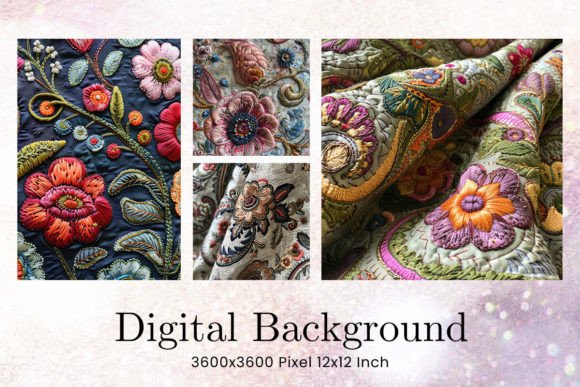
Flower Embroidery Fabric Background
As an embroidery designer who’s prepped over 200 craft fair booths—and shipped thousands of handmade products to Etsy sellers, boutique makers, and small shop owners—I’ll cut straight to it: Flower Embroidery Fabric Background is a quietly powerful design asset. It doesn’t shout. It doesn’t rely on novelty or trend-chasing. Instead, it delivers consistent visual warmth, subtle texture, and quiet sophistication—exactly what sells at markets where shoppers pause, touch, and imagine how something feels in their own kitchen, garden, or living room.
A First Impression That Builds Trust
Right away, the title tells me this isn’t a cartoonish floral or a hyper-saturated digital print—it’s grounded in embroidery fabric. That phrase alone signals authenticity to handmade buyers. The mood? Softly elegant with rustic charm—think heirloom linen, vintage tea towels, and slow-made aprons—not loud festival energy or maximalist decor. It lands as premium but approachable, decorative but never fussy. And because it arrives as a high-res 300 DPI JPG set (four files), it’s clearly built for flexibility: sublimation on polyester blends, digital printing for fabric yardage, or use as a layered background in graphic design for printable mockups and Etsy listings.
Where It Shines on Craft Fair Products
This isn’t a standalone motif meant for center-stage monogramming. Flower Embroidery Fabric Background excels as a supporting layer—elevating otherwise simple items into curated, intentional pieces.
- Tote bags & market bags: Printed full-bleed on natural canvas or unbleached cotton, it reads as artisanal—not mass-produced. Customers notice the soft botanical rhythm before they even read your tagline.
- Aprons & tea towel embroidery: Use it as a printed base fabric, then add minimal machine embroidery (a single stem, monogram, or border) on top. The background does the heavy lifting; your stitchwork adds personality.
- Pillow covers & pouches: Small-scale repeats hold up beautifully when scaled down. No pixelation, no muddy edges—just gentle texture that invites fingertips.
- Embroidered patches: While Flower Embroidery Fabric Background itself isn’t a patch file, its JPGs are ideal for printing onto patch blanks *before* stitching borders or details—giving your patches depth and dimension most vector-only designs can’t match.
- Booth samples & printable mockups: As a Graphics asset, it’s gold for creating cohesive vendor displays. Print it on cardstock for mini fabric swatches, layer it behind product photos, or use it in Canva templates for Instagram Stories—consistency builds brand recognition fast.
What Makes It Sell—And What Demands Attention
At a craft fair, attention spans are short and tactile curiosity is high. Flower Embroidery Fabric Background wins because it’s instantly legible at 3 feet—but only if applied thoughtfully.
It works brilliantly as a large-scale focal background (e.g., full-print tea towels), but avoid shrinking it below 4” x 4” on small items like keychain pouches or cap brims—the delicate stems and petal spacing may blur on curved or textured surfaces. On dark fabric? Test contrast first: light-toned florals recede unless paired with tone-on-tone thread or foil accents. On thick canvas or terry cloth towels? The JPG’s soft edges actually soften further—so lean into that. Let the texture *enhance*, not compete.
For Etsy sellers and digital designers: this background scales cleanly across listing thumbnails, banner headers, and packaging inserts. Its neutral palette (implied by “fabric background” and embroidery context) pairs effortlessly with earthy thread colors—olive, oat, slate, terracotta—making color coordination intuitive, not stressful.
Production Notes Every Embroidery Designer Should Check
Even though Flower Embroidery Fabric Background is a digital file—not a machine embroidery design—you’re still responsible for how it translates into a finished product. Here’s what I test before cutting a single yard:
- Print a swatch on your target fabric: Sublimation on polyester behaves differently than direct-to-garment ink on cotton. See how the flowers hold detail.
- Check thread contrast on mockups: If adding embroidery on top, ensure your thread colors lift—not disappear—against the background’s tonal range.
- Review spacing for repeat alignment: Since it’s delivered as four JPGs, confirm seamless tiling for yardage or large panels. Some files include bleed guides; others don’t—verify before bulk printing.
- Confirm commercial licensing: This is a digital embroidery file for backgrounds—but does your sublimation printer or POD partner allow resale of finished goods? Don’t assume.
- Create one real-world sample: Not digital. Not a screenshot. A stitched, printed, pressed, hung tote bag—held in natural light, photographed next to your other bestsellers. That’s your truth test.
Why It Strengthens Your Booth—and Your Brand
In a sea of bright fonts and glittery slogans, Flower Embroidery Fabric Background whispers quality. It signals care, intention, and textile literacy—traits handmade buyers actively seek. When grouped with hand-stitched tea towels or linen aprons, it reinforces cohesion without demanding uniformity. It gives your booth visual breathing room. It makes your price point feel justified—not because it’s expensive, but because it feels *considered*.
For Cricut crafters, digital sellers, and small shop owners: treat this as a foundational design asset—not just another download. Layer it behind custom quotes, pair it with minimalist line-art motifs, or use it to unify seasonal collections (spring samplers, summer picnic bundles, autumn harvest sets). Its strength lies in restraint, repetition, and resonance.
If you’re building a recognizable handmade business—one where customers return not just for the product but for the feeling it carries—Flower Embroidery Fabric Background isn’t filler. It’s framing. It’s foundation. And in the right hands, it’s quietly unforgettable.