Lotus Flower - Celestial Embroidery
A Designer’s Real-World Review for Small Business Merchandise
As an embroidery designer who’s developed and tested hundreds of machine embroidery designs for small business clients—from neighborhood cafés and florists to handmade pet brands and boutique studios—I approached Lotus Flower - Celestial Embroidery with both curiosity and practical scrutiny. The title evokes serenity, intention, and quiet elegance—qualities that resonate deeply with mindful brands. But for a small business owner or apparel decorator, elegance must translate into durability, versatility, and brand clarity. This isn’t just decorative; it’s functional branding stitched in thread.
First Impression: Calm, Cohesive, and Commercially Ready
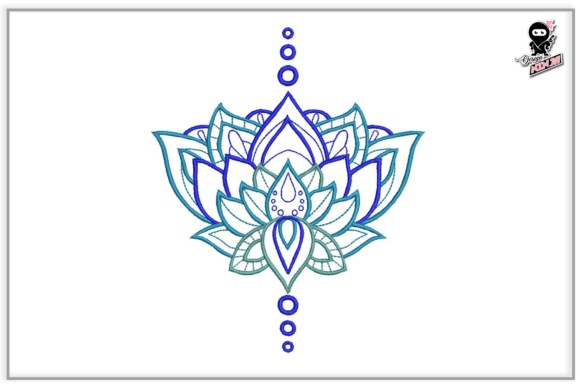
Right away, Lotus Flower - Celestial Embroidery reads as modern yet timeless—neither overly ornate nor starkly minimal. As an Outline Flowers design, it leans into clean line work rather than dense fill, which is ideal for small business merch where subtlety and recognition matter more than visual noise. It feels premium without being pretentious, friendly without sacrificing sophistication—perfect for a yoga studio’s aprons, a botanical bakery’s tote bags, or a local florist’s staff caps. That balance is rare, and it signals strong design discipline behind the Embroidery file.
Where It Shines in Everyday Business Use
Lotus Flower - Celestial Embroidery performs exceptionally well across high-impact commercial applications:
- Embroidered patches: Its balanced negative space and clear silhouette hold up beautifully at 2"–3" sizes—ideal for iron-on or sew-on patches on jackets, backpacks, or shop signage.
- Staff uniforms & aprons: On chef coats, café aprons, or boutique smocks, it adds identity without overwhelming function. The outline style avoids bulk, reducing wear fatigue around seams.
- Cap embroidery: When scaled to 2.25" wide, the lotus retains legibility on curved front panels—especially with proper underlay and stabilizer choice.
- Tote bag design & product packaging accents: As a subtle chest or corner motif, it elevates unbranded canvas or kraft paper packaging without competing with typography or photography.
- Etsy branding & handmade product tags: Paired with a simple tagline (“Hand-poured • Locally Grown”), it reinforces authenticity and care—key emotional triggers for craft buyers.
This design doesn’t shout—it invites. That makes it especially effective for businesses building trust through consistency: think repeat customers spotting the same lotus on a barista’s sleeve, a bakery box sticker, and a reusable shopping bag.
Where to Use It Thoughtfully
Like any strong machine embroidery design, Lotus Flower - Celestial Embroidery has boundaries worth honoring:
- Avoid sub-1.75" patch sizes—fine details in the celestial elements (subtle star-like nodes or delicate petal tips) may blur or stitch inconsistently on very small hoops.
- Curved surfaces like cap fronts demand careful digitizing review. Confirm the file includes optimized underlay and reduced stitch density in tight curves—otherwise, puckering risks increase.
- Dark uniforms or textured fabric (e.g., heavy linen aprons) require higher-contrast thread colors. Test black-on-navy or charcoal-on-cream—not just white-on-black—to ensure definition.
- Frequent washing cycles favor moderate stitch density over ultra-fine linework. If your client’s merch goes through commercial laundries weekly, request a simplified version—or confirm the file avoids fragile jump stitches near petal ends.
Brand Identity Impact: More Than Just a Pretty Stitch
For small businesses, every embroidered detail contributes to perceived value and cohesion. Lotus Flower - Celestial Embroidery strengthens brand identity by offering visual continuity across touchpoints: the same graceful shape appears on a staff cap, a customer gift pouch, and a printable mockup for social media—and it reads as intentional, not accidental. That consistency builds recognition faster than changing logos or fonts per platform.
It also supports a handmade product narrative without leaning into cliché. Unlike overused “vintage” motifs or generic leaf clusters, this lotus carries quiet symbolism—growth, resilience, presence—that aligns organically with wellness brands, eco-stores, and artisan makers. Customers don’t just see a flower; they feel alignment with values.
Practical Notes Every Embroidery Designer Should Run Through
Before sending Lotus Flower - Celestial Embroidery to production—or recommending it to a client—here’s my checklist:
- Test in black and white first: Print a grayscale mockup to assess contrast and spacing—no thread color illusions masking weak line weight.
- Verify small-patch performance: Resize to 2" and run a sample on your target fabric. Does the central node remain distinct? Do outer lines stay crisp?
- Review thread color contrast: Especially for dark garments—light threads need sufficient coverage; dark threads need enough sheen to avoid looking muddy.
- Inspect spacing between elements: Tight loops or intersecting outlines can cause nesting or thread breaks on older machines.
- Confirm hoop size compatibility: Does it fit standard 4x4 or 5x7 hoops? Or does it require larger framing—impacting turnaround time and cost?
- Test on real fabric + stabilizer combo: A cotton twill apron behaves differently than a polyester cap front. Always stitch before quoting.
- Create a client-facing printable mockup: Show how it looks on their actual garment or tote—context transforms approval speed.
- Compare beside other design assets: Does it scale and tone-match your logo, website font, and packaging palette?
- Confirm commercial licensing: Since this is for small business merch, custom apparel, and commercial embroidery, verify the digital embroidery file includes rights for resale and branding use—not just personal projects.
Remember: the strength of Lotus Flower - Celestial Embroidery lies not in its intricacy, but in its intentionality. It’s a tool—not just a decoration—for businesses stitching their story, one precise, meaningful loop at a time.